
The benchmark that misses the mark
Most businesses ask what an agency charges, then compare it to a salary they’ve seen advertised. The comparison falls short because you're comparing one person's time with a broader marketing function.
When a manufacturing or wholesale business decides to invest more in marketing, the default move is often to hire a marketing manager. The salary gets approved, someone starts and twelve months later the business has activity but no measurable programme.
The reason is structural. Gartner's 2026 CMO Spend Survey found that labour accounts for 24.5% of a marketing budget. Paid media accounts for a further 31.4%, with the remainder spread across other marketing resources. A single hire accounts for the labour quarter, but not the wider investment needed to turn activity into measurable outcomes.
What a marketing hire actually costs
Base salary is only part of the picture. Superannuation is 12% of ordinary time earnings, and from July 2026 employers must pay it within seven business days of each payday rather than quarterly. On top of that sit payroll tax, workers’ compensation, recruitment fees, software licences, training, equipment and the management time to direct someone who is often the only marketer in the business.
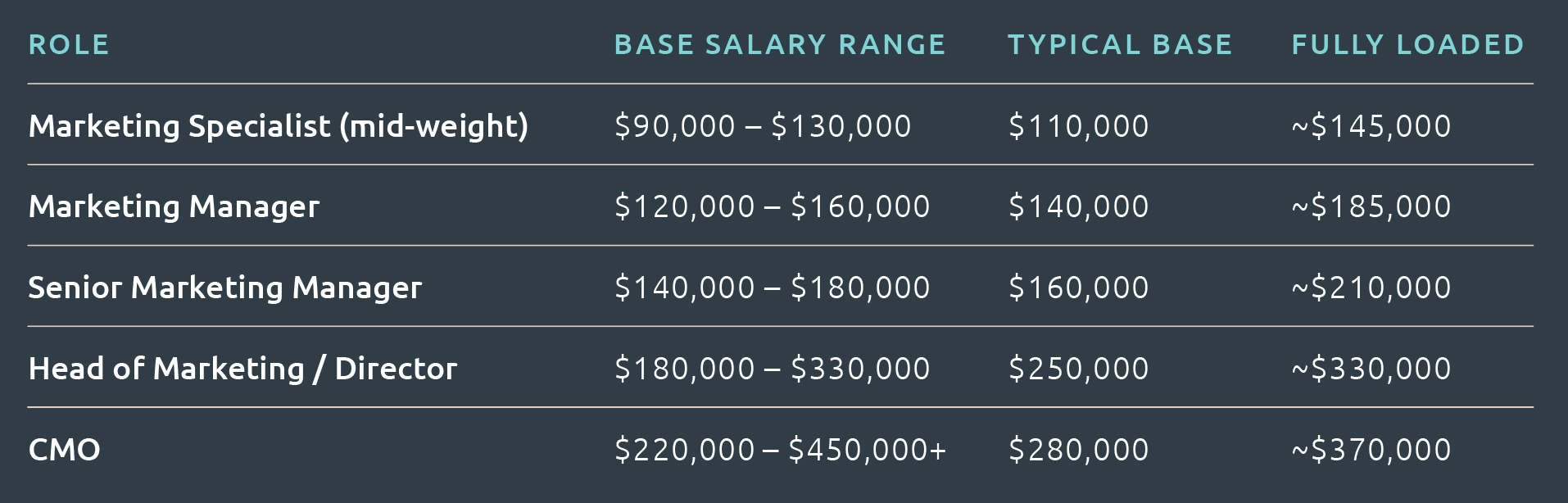
Fully loaded cost applies a consistent 32% loading to the typical base salary: 12% superannuation, around 5% payroll tax above state thresholds, 1% workers’ compensation and approximately 14% for recruitment, software, equipment and training.
None of this includes the budget needed to run marketing activity, such as paid media, events, production or campaign costs. There is also the risk of relying on one person, with limited backup if they leave, are unavailable or don’t have a particular skill set.
What Gartner says about marketing budgets
Gartner's 2026 CMO Spend Survey polled 401 CMOs and marketing leaders across North America, the UK and Europe between January and March 2026. It found marketing budgets sitting at 7.8% of company revenue: effectively flat year on year, and around 18% below where they sat four years earlier.
That figure needs a caveat. Most respondents report annual revenue above US$1 billion. In our experience, Australian B2B businesses in manufacturing, wholesale and professional services commit considerably less, commonly between 2% and 5% of revenue.
- A $20 million manufacturer investing 3% of revenue is looking at $600,000 a year.
- A $50 million business at 4% is around $2 million.
- A $10 million business at 2% to 5% is between $200,000 and $500,000.
Set against those figures, a $140,000 marketing manager is only part of the investment. The broader marketing function still needs funding.
Three tiers, set by turnover and complexity
The level of marketing function a business needs comes down to annual turnover, growth ambition and complexity: the number of distinct service lines that each require separate marketing support.
Complexity can move a business up a tier regardless of turnover. A $60 million manufacturer selling one product into one market may be simpler to service than a $25 million business running four divisions.
- Tier 1: Core | up to $20m
One audience, one strategy, delivered end to end. Equivalent to a mid-weight marketing manager, with a fully loaded cost of around $185,000. - Tier 2: Growth | $20m to $50m
Two or three offers running in parallel, with ABM against named targets. Equivalent to a senior marketing manager, with a fully loaded cost of around $210,000. - Tier 3: Complete | above $50m
For multi-division businesses requiring a broader marketing function. Equivalent to a marketing director or CMO, with a fully loaded cost of around $330,000 to $370,000.
Why ABM belongs in a B2B programme
Account-based marketing focuses on a defined list of target accounts rather than a broad audience. In B2B, it reflects the way buying decisions are made, building awareness and relationships with key decision-makers over time.
Gartner research into B2B buying groups found they can range from 5 to 16 people across as many as four separate functions, with 74% of buyer teams showing unhealthy conflict during the decision process. The same research found content relevant to the buying group as a whole improves consensus by 20%, while content relevant only to individuals within that group reduces consensus by 59%.
Gartner's March 2026 sales research also found 67% of B2B buyers prefer a rep-free buying experience, and 45% used AI during a recent purchase. Your prospects research, compare and shortlist well before anyone from your business speaks to them.
Why a blended monthly fee beats line-item pricing
The alternative to a monthly retainer is a rate card, with the website, campaigns and content priced separately. When every activity is treated as a separate piece of work, it's harder to adapt the programme and respond to changing priorities.
- Every change becomes a quote: Across a year, a significant share of the programme goes into administration.
- Work stops when one element stalls: Under a line-item arrangement, paid work can halt and the month is lost.
- It discourages the right conversations: When every request carries a price, people think twice before asking.
- It misaligns the incentive: Line-item pricing pays for output. A blended fee pays for a programme.
Make your numbers work for you
Take the seniority of the person you would need to hire, add the true cost of employing them, factor in the activity budget and consider whether one person can realistically cover the full marketing scope. For most B2B businesses in manufacturing, wholesale and professional services, the numbers often favour a broader marketing function.
The right model gives your business the clarity, consistency and capability to get more from its marketing investment. That means staying top of mind, building demand and winning more of the business you want.